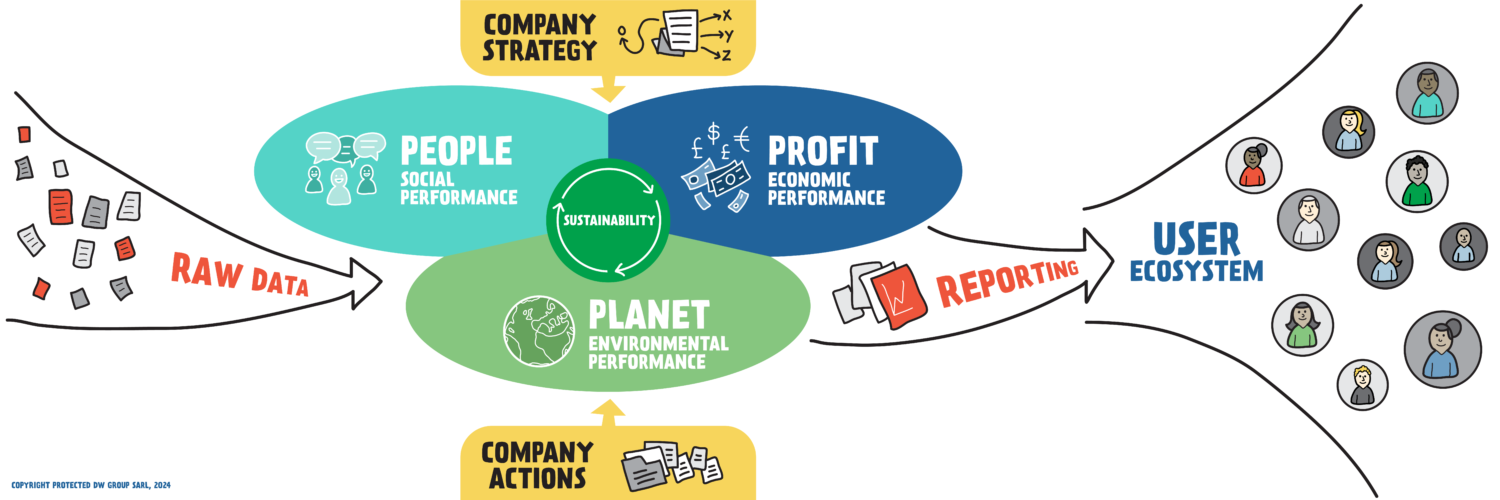

Profitable Sustainable Businesses: Fact or Fiction?
A few short years ago businesses were under growing pressure to transition towards net zero. Standard setters worked tirelessly to respond to market demands to issue sustainability standards on reporting, assurance and ethics. Fast forward to today, and the tables have turned. Governments are eliminating or reducing expectations on business, businesses in turn are revisiting their sustainability strategies.
It is a familiar deregulation story; however, two important realities remain present:
- The underlying issues that gave rise to the original sustainability movement – climate change, inequity, inequality, degradation of nature, lack of ethics and corruption, amongst other things – still exist.
- Business longevity remains tied to these issues (that is, the first reality), and financial viability risks remain absent action.
This raises a natural question. Is it possible to implement a profitable sustainable business, or is it, as some suggest, a cost prohibitive path that will destroy businesses?
Profit Maximization versus Sustainable Business
What exactly is the purpose of business? A simple question on the surface but one that can derive a multitude of answers depending on one’s point of view.
The World Economic Forum (WEF) stated: “Increased emphasis on top-lines and bottom-lines has alienated people and communities from business…Businesses today need a higher purpose, which rises above profitability concerns.”
The Harvard Business School (HBS) found that “Some of the most successful companies focus beyond profit margins and returns on investments to craft strong mission statements and purpose-driven strategies. These businesses prove it’s essential to ask: How can I build a sustainable business and serve people?”
The business case to look beyond a strategy of profit maximization to consider a purpose driven strategy is also widely recognized as the link to maximize company value, however there are dissenting voices which are still playing out quite publicly.
So, what does this mean in practical terms for the business itself?
Before embarking on any journey, management should start by asking itself some basic questions:
- What risks do I face?
- Where do those risks sit (i.e.: within the business, within its value chain or within both)?
- How are those risks being managed today?
Consequential Thinking
When contemplating business risks, the talent arguably lies in being able to push risk identification into the “so what” and “then what” arena.
If we use increasing temperatures (aka climate change) as an example. Within a consequential thinking approach, a food producer would rightly identify it as a risk to their business. Now, we take it further and consider the “so what” and “then what”. Climate change affects obvious things like assets (the “so what”). It may have to abandon agricultural lands, buildings and equipment if the local environment no longer lends itself to growing crops (either because of excessive heat or lack of water), in other words the assets would no longer be revenue generating.
So, what are the less obvious risks?
Consider the impact of rising temperatures on business talent (a “then what” element). Talent is impacted in many ways, a couple of which are:
- Persistently high or rising temperatures may cause individuals to relocate to cooler climates – risking the loss of key talent as well as the potential lack of access to new talent.
- Rising temperatures also result in a loss of productivity, a 2–3% loss for every degree increase beyond 20°C in Wet-Bulb Globe Temperature[1] directly impacting the business bottom line.
This simplified example shows why the question of a profitable sustainable business being fact or fiction is, in fact, a misnomer. The real question is how to ensure a viable and sustainable business which profitably thrives for decades to come.
One Step at a Time
Every journey starts with a single step. Becoming a sustainable business requires a holistic approach that integrates sustainability into every aspect of its strategy, operations and management. Thinking through the “so what” and “then what” questions that ensure an end-to-end understanding of the business, its dependencies, risks, impacts and opportunities. A profitable sustainable business commitment enhances long term profitability, benefits the environment, and promotes human well-being.
[1] WHO research finding, Wet-Bulb Globe Temperature is a measure of heat stress that takes into account air temperature, humidity, wind speed, sun angle, and cloud cover.
Image credit: PINIMG
